

The foothills of the Himalayas: Basmati rice
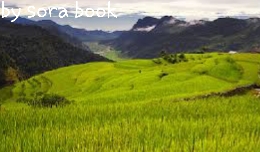
Although India grows many different varieties of rice, basmati is the best known
outside its country of origin. This beautiful, aromatic (the name basmati means
“fragrant”), long-grained rice finds the climatic and soil conditions at the bases
of the Himalayan mountain range ideal.
In India, basmati rice is considered special and is more expensive than other rice
varieties. This is because it’s a uniquely slender grain that cooks up fluffy, a trait
that’s valued in Indian cooking. To enhance this quality of cooking into separate
grains, it’s aged in warehouses where conditions such as light, air, temperature,
and humidity are highly controlled. This results in each grain drying and forming
a light skin, which can effectively seal the grain and help lock in the starch. The
aging process can take anywhere from a year and a half to two years, the longer
period yielding a more expensive rice.
When the British divided India at the time of independence in 1947, a part of this
basmati-growing territory fell in the newly formed country of Pakistan. The cui-
sines of both countries celebrate this superlative grain in dishes such as biryani
and pulao.
Punjab and the Partition of India
A number of Indians who live outside of India are Punjabi in origin. Around the
time of Partition, when the state of Punjab got divided, Hindus living in the newly
formed country of Pakistan and Muslims living in the Indian part of Punjab
crossed borders, giving rise to one of the world’s largest human migrations. The
chaos, genocide, and displacement meant that some people fled to postwar Britain
where jobs were available along with the opportunity to begin life anew.
They brought with them the unique food of the North — so much so that, today,
in many parts of the world, when someone talks of Indian cooking, it’s Punjabi
food that they’re referring to. Rich onion- and tomato-flavored curries, aloo gobi,
saag paneer, or the delicious tandoori foods (cooked slowly in a clay oven called
the tandoor), even the naans and parathas, all came from Punjab
Ingredients that you would commonly find in a Punjabi kitchen are beans such as
chickpeas and red kidney beans; black lentils; vegetables such as cauliflower,
potatoes, peas, and turnips; and whole-wheat flour to make many kinds of breads.
Punjab grows a lot of wheat and was once known as the granary of India.
There are many stories about how tandoori cooking came to be associated with
India. It was already being used in undivided Punjab and, after Partition, found its
way to the Indian side of the state. Because a tandoor is quite large and needs to
be brought to the right temperature over some time (as you do with a barbecue),
it was impractical for every Punjabi home to fire one up every evening. Communal
tandoors were set up, with each village having one. People prepared their dough
at home and took it to the village tandoor to have their rotis cooked. Eventually,
commercial tandoori shops offered cooked breads to take away, and the commu-
nal tandoor became less of a ritual; today, only a few villages have one.
Kashmir and its saffron fields
Kashmir is one of the most beautiful states of India, resplendent with green val-
leys, flowing waterfalls, pine forests, and fruit-filled orchards. Due to its proxim-
ity to the Himalayas, Kashmir was the natural passage to India for many invaders.
Its cuisine is, therefore, a mix of Indian, Persian, and Afghan styles.
The cooking of Kashmir is best showcased in the Wazawan or traditional Kashmiri
feast. Even today, the master chefs of Kashmir are hailed as the descendants of the
traditional chefs from Samarkand, the Wazas who came to India with the ruler
Timur when he entered India in the 15th century. The royal Wazawan, comprising
36 courses, is a feast that few can get through. The meal begins with the ritual of
washing the hands. Then the tramis (dishes filled with food) begin to arrive. The
entrees are eaten with a sticky, dense variety of rice, which is prized. Much of the
Wazawan is meat-based because this is a sign of affluence, but vegetarian dishes
with lotus root or potatoes are also served.
Two distinct groups of people live in Kashmir — the Muslims and the Hindus —
and their cuisines are also distinct. Spices such as dried ginger, ground fennel, and
saffron, which grow in Kashmir, are used. This state is known for its quality saf-
fron. The bright red stigma of the saffron crocus flower produces the spice, which
is considered the most expensive one in the world. The cost is due to the labor-
intensive harvesting process where around 200,000 stigmas need to be collected
to make up a pound of saffron!Saffron is even used in the tea in Kashmir. Kahwa is green tea flavored with saf-
fron, spices, and nuts.
The food of East India is also influenced by trade and colonization. Parts of this
region share a border with neighboring China and Myanmar, so those influences
are evident; you’ll find ingredients such as pork, bamboo shoots, and soya beans.
Don’t be fooled into thinking that all the food here is gentle and mild — this
region is also home to one of the world’s most fiery chilies, the bhut jolokia, or
ghost chile, which is so hot that one little taste and you yourself will become a
ghost.
Tea and the British
Have you heard that India is one of the world’s largest producers of tea? Much of
it is drunk in house, so we have a nation of tea lovers. The industry as we know it
today was introduced to India by the British. The Dutch had brought tea back to
Europe from the 17th century, and the British considered it to be both a medicinal
and a refreshing drink.
China was the only country growing tea at the time, and the British wanted to top-
ple China’s monopoly. So, they smuggled opium into China with the aim of
exchanging it for tea and even got Bengali farmers to grow opium for them instead
of staple crops needed to feed the masses. This did not impress the Chinese.
Early tea plantations were set up in the hilly regions of Assam from 1837. Soon
after, tea estates mushroomed in Darjeeling. Both these eastern areas had perfect
growing conditions, and even today, driving through the beautiful mountain
roads, you can only admire the step plantations carved into every hillside.
In India, everything needs to be spiced with masala, so it isn’t surprising that the
brew was enhanced with ginger, cardamom, and fennel seeds to make Masala
Chai (Spiced Tea; see Chapter 21). The Indian word for tea is chai, and I’ve heard it
comes from the Chinese word cha. This delicious brew has caught the world’s
fancy (although strangely called chai tea, which translates as “tea tea,” in the
West) and seems to be a much-loved flavor in lattes and ice creams.
Kolkata and Bengali sweets
The mere mention of Indian sweets, and I see eyes being rolled and a muttered,
“Too sweet for me.” Most people not of Indian origin think of all Indian sweets as
being cloying. But wait, have you ever had a box of chocolates? It’s the same prin-
ciple: Commercially available sweets have a lot of sugar to increase their shelf life.
Indian homemade desserts are subtly flavored confections (see Chapter 21 for
some easy and delicious recipes) bursting with fruit, milk, spice, and all things
nice.
The eastern state of Bengal is particularly known for its sweet offerings. Accord-
ing to historians, the original name of the area was Gauda, derived from the San-
skrit word for jaggery, the sweet, thickened juice of sugarcane. Because this crop
grew here in plenty, and old texts affirm this, it can be safely said that sweets were
an important part of the cuisine for several centuries.
But Bengali sweets are unlike those of anywhere else in the country, mainly
because many are made with cottage cheese as a base. I’ve heard that the Portu-
guese, who were in India before the British, brought the skill of cheese making to
Bengal. The Hindus considered the curdling of milk taboo, but that didn’t stop
them from falling in love with the resulting delicacies. They quickly created reci-
pes using fresh cottage cheese, spices, sugar, and nuts and produced pillowy-soft
confections that melted in the mouth and left you wanting more. As these began
to be mass produced in factories, the sugar content increased. Today, the gulab
jamuns and ras malai you see on Indian restaurant menus have set the stage for
everyone thinking that all Indian sweets are syrupy sweet.
Odisha and fish with everything
The state of Odisha enjoys a long coastline along the Bay of Bengal, so it’s hardly
surprising that fish features regularly on many dinner tables there. Lying on the
east coast, Odisha nestles between the South and the North, so the food is inspired
by both. The Northern part of Odisha, which borders Bengal, uses mustard paste
in curries, whereas southern districts use tamarind, in keeping with South Indian
traditions.
I don’t hear people around the world talk much about Odia cooking, but this state
has produced some of the best cooks of the East. They’re known for a simple yet
flavorful style, so they’re in high demand in other parts of India. Many centuries
ago, Odisha built maritime trade ties with Bali in Indonesia, and no doubt they
also introduced Indian spices and curry pastes to that land.
----------------------
------------
------------------------

No comments:
Post a Comment